


”In politics, rallies, meetings and promises are often part of the journey. But for ordinary people, what matters most is whether their representative understands the problems they live with and can turn their concerns into something tangible.”
By JAMES S. SWAM
For Senator Sunday Marshall Katung, representing Kaduna South Senatorial District is more than occupying a seat in the Senate. It is about knowing the people he represents, understanding the challenges they face and finding practical ways to respond to those challenges.
In politics, rallies, meetings and promises are often part of the journey. But for ordinary people, what matters most is whether their representative understands the problems they live with and can turn their concerns into something tangible. From communities waiting for electricity to young people looking for opportunities and families needing access to healthcare, Senator Katung’s activities in recent months suggest a deliberate effort to remain connected to the everyday realities of his constituents.
Senator Katung therefore appears to have established a significant advantage in the Kaduna South Senatorial District with his understanding of the challenges in various communities and the steps developed to solve them.
Since June, the senator’s activities have offered a clear picture of a representative who is not only familiar with the geography and diverse interests of his constituency but also appears to understand what representation at the National Assembly should mean. His interventions have ranged from youth development and sports to rural electrification, healthcare and public health advocacy.
Taken separately, these activities may appear modest but when viewed together, however, they suggest a deliberate approach to representation, which includes identifying a need, connecting it to the appropriate institution or intervention and pursue it until it produces a tangible benefit for the people. That is where Katung’s advantage over those attempting to replace him becomes particularly significant.
Kaduna South Senatorial District is a large and diverse constituency, comprising communities with very different needs. While some areas are relatively urbanised and connected to major economic centres, others continue to struggle with basic infrastructure and access to essential services. Effective representation therefore requires more than a generic development agenda.
It requires knowing that a young person in an urban community may be looking for opportunities in sports, skills or entrepreneurship, while a rural community may still be asking for electricity, roads, water or a functional health facility. Katung’s activities since June demonstrate an awareness of this diversity.
Football Academy Partnership
On June 9, for instance, the senator met with the Chief Executive Officer of Ikon Allah Football Academy, Ayi Mohammed to explore partnership opportunities for promoting grassroots football and sponsorship among young people in the Senatorial Zone. On the surface, a meeting about football may seem far removed from the traditional responsibilities associated with a senator, but it reflects a deep understanding of youth development and a need to promote young, talented footballers for possible placement in top European and international clubs.

For a constituency with a large youthful population, sports can be a platform for talent discovery, discipline, social development, employment and access to international opportunities. The important point is that the senator met a football academy operator to look at ways of connecting young people in his constituency to opportunities beyond conventional government programmes.
This is an important milestone because it is about creating partnerships and opening of doors through which constituents can access greater opportunities with clubs across our shores.
Lighting Up a Community
One of the strongest evidence of Katung’s grassroots presence, however, may be found in Aban Community in Sanga Local Government Area. In August, the senator commenced an electrification project that will connect Aban to Gwantu through the installation of more than 200 electricity poles.
The significance of the project is beyond imagination and a pleasant surprise to the community leaders. According to Katung’s media adviser, Midat Joseph: “the people of Aban have lived without access to electricity, relying on candles, lanterns and torches,” for generations. For the residents, therefore, the electricity project is an important infrastructure that could open up the community.
The reaction of the District Head of Aban, His Highness Mallam Mamman Umaru, captured the emotional significance of the intervention. He described it as the fulfilment of a wait that had lasted for generations, pointing to the opportunities the project could create for women, young people and businesses.
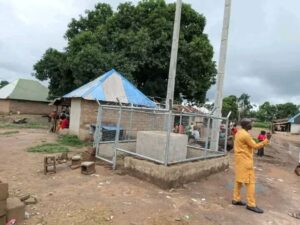
”For 200 years, we have waited. Today, our children are seeing the signs that the end of darkness is near. Our women will be able to grind in the evening, our young people will have greater opportunities, and I am grateful to witness the coming of electricity in my lifetime. May God bless Senator Katung,” the district head said.
Katung’s own description of the project is instructive. Development, he argued, must translate into tangible improvements in the lives of people irrespective of where they live. “No community should be forgotten because of where it is located. When you light up a village, you do not only provide electricity, you light up possibilities, create opportunities and illuminate the future of generations to come.”
That statement reveals an understanding of a fundamental problem of constituency development, that is, the tendency for remote communities to be overlooked because they are politically or geographically less visible. Fortunately, Senator Katung pays attention to such communities by demonstrating something that campaign rhetoric cannot easily manufacture – the knowledge of where the gaps in rural development actually exist.
PHC and Health Advocacy
Barely a month later, another intervention provided further evidence of this approach.
On September 4, Katung commenced construction of a primary healthcare centre in Ghauta Community, Jema’a Local Government Area. Again, the choice of location and the nature of the project are significant. Healthcare is one of the areas where rural communities often experience the greatest disadvantage. A distant or poorly equipped health facility can mean that pregnant women, children and elderly residents face serious difficulties accessing care.
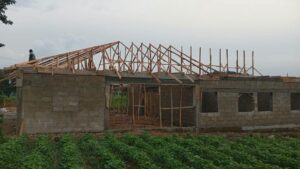
The Ghauta PHC intended purpose is to bring healthcare closer to the people and improve access to antenatal and child-delivery services. For a senator, this is a practical way of addressing a problem that may not receive adequate attention in broad national policy discussions. It also illustrates the connection between legislative representation and constituency intervention.
In the case of the diphtheria concerns reported in neighbouring states, for example, SMK moved into the area of public health advocacy. On September 10, he urged constituents to remain vigilant and encouraged vaccination, hygiene and early reporting of suspected cases.
Importantly, he issued a press statement notifying that he had reached out to relevant health authorities and would continue collaboration with the Kaduna State Government and the National Primary Health Care Development Agency to strengthen surveillance and ensure the availability of vaccines and medical supplies.

That is what is called effective representation – identify an emerging concern, inform constituents, engage responsible institutions and encourage preventive action. Indeed, the early advocacy helped to prevent diphtheria from infecting the constituency from the neighbouring Plateau state, one of the affected states in Nigeria.
And while this piece was being researched, stories went viral about SMK being seen along the Zonkwa-Kachia express way inspecting the commencement of the construction of a 700-capacity ICT/CBT centre for students. This gigantic project is situated in Zonkwa, headquarters of Zangon Kataf local government to bring JAMB centre closer to prospective students. This would reduce the danger of travelling to far distances during such examination periods.
As The Next Election Approaches
Perhaps the most compelling feature of Katung’s recent activities is that they fit into a single political slogan – get involved to trust the process.
Those seeking to challenge Katung have one obvious disadvantage – they can only promise what they would do if elected. But Katung has something different, the ability to point to what he has done or already doing. They must not only explain why they should be elected, they must persuade voters that they can perform better than an incumbent whose interventions are increasingly visible in communities.
As the next political contest approaches, the question facing voters in Kaduna South Senatorial Zone may therefore be less about who can make the most attractive promises and more about who understands the constituency well enough to identify its real problems and has demonstrated the capacity to act.
That is where Katung currently appears to have an advantage. He knows his constituency.
Swam is a Kaduna-based writer






Leave a Reply